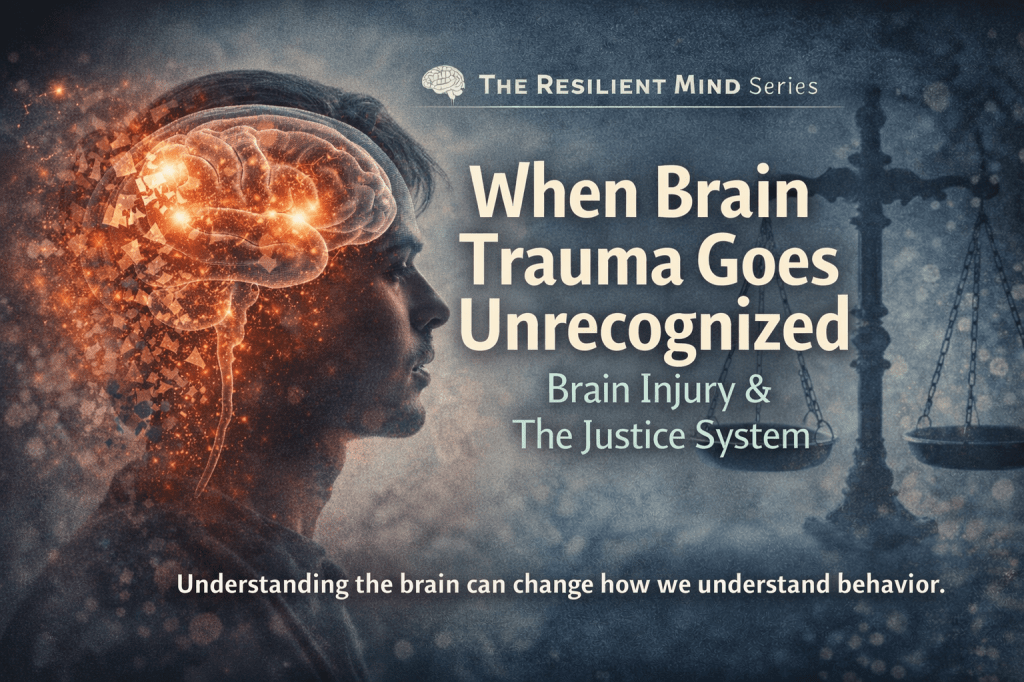
The Resilient Mind Series
Understanding Brain Injury — Post 3
In the previous article, we discussed how brain injuries can affect behavior. When the brain is injured, changes in memory, impulse control, mood, and emotional regulation can follow.
But what happens when those changes are never recognized for what they are?
This question becomes especially important when we look at how people interact with larger systems such as education, employment, and the justice system.
One of the most commonly overlooked factors in these situations is Traumatic Brain Injury (TBI).
When someone experiences trauma to the brain, it can affect how they process information, regulate emotions, and make decisions. These neurological changes are often invisible, and without proper awareness or evaluation, they may go completely unnoticed.
A person dealing with a brain injury may struggle with:
- Impulse Control
- Emotional Regulation
- Memory and Concentration
- Decision-Making Under Stress
- Processing Complex Information
From the outside, these struggles may appear as poor choices, bad behavior, or lack of discipline.
But the reality is often far more complicated.
If a brain injury has occurred and no one recognizes it, the person may never receive the support or treatment that could help them recover or adapt.
Instead, they may simply be labeled as difficult, irresponsible, or disruptive.
This is why awareness matters.
Understanding brain health allows communities, educators, employers, and institutions to ask better questions when someone is struggling.
Rather than immediately assuming the problem is character or attitude, awareness opens the door to consider whether something deeper may be happening neurologically.
Recognizing the role brain injuries can play in behavior does not excuse harmful actions. However, it can provide important context for understanding why someone may be struggling.
The more we learn about brain health, the more we begin to see that many challenges people face are connected to how the brain processes trauma and stress.
Awareness helps us move beyond simple labels.
It allows us to replace judgment with understanding and to recognize that healing and support can sometimes make the difference between someone continuing to struggle or finding a path forward.
Interested in a Brain Injury Screening?
Brain injuries often go unnoticed for years.
If you or someone you know has experienced head trauma, memory issues, emotional changes, or difficulty concentrating, it may be worth learning more.
If you are interested in a Traumatic Brain Injury (TBI) screening, leave your information below and someone will reach out to you shortly.
Please include:


A member of our team will follow up with you to discuss available resources and next steps.
Understanding the brain is the first step toward healing.



 The Resilient Mind
Leave a comment