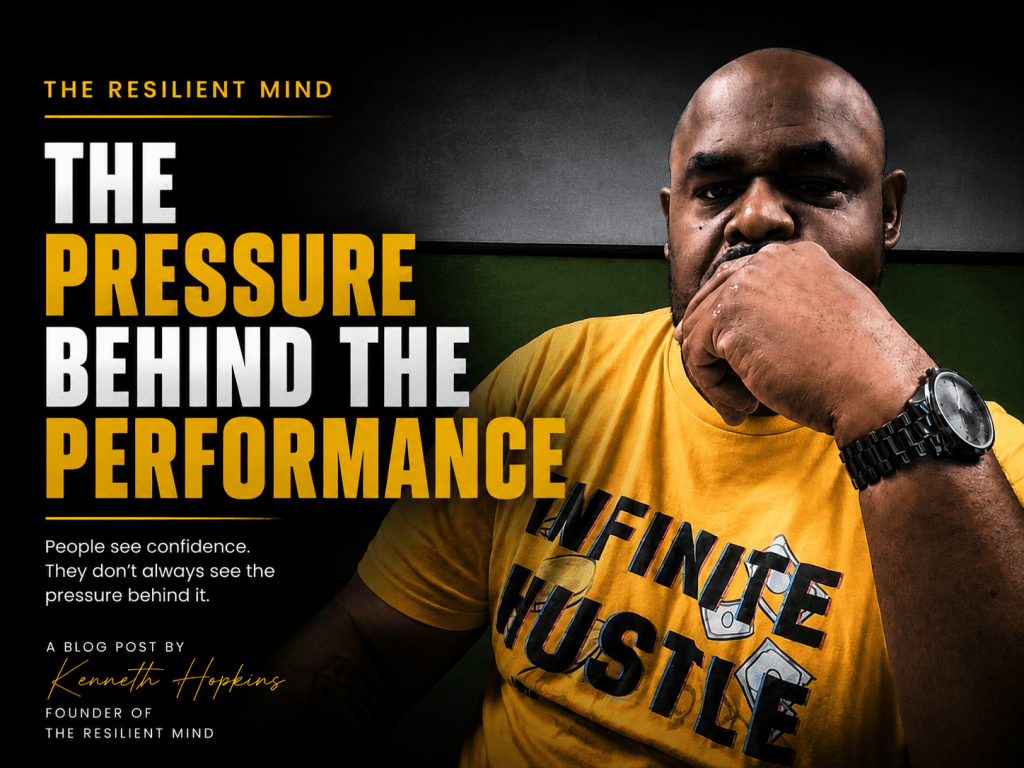
People see confidence. They don’t always see the pressure behind it.
There’s a certain kind of pressure many people carry that never gets talked about.
Not because it doesn’t exist.
But because the people carrying it usually look “strong” to everyone else.
They’re the dependable ones.
The hard workers.
The leaders.
The providers.
The people who always seem composed under pressure.
But what happens when strength itself becomes a survival mechanism?
What happens when the performance of confidence is really just fear wearing a strong face?
That’s something I’ve been forced to think about lately.
The Misunderstanding of “Strong”
People often assume that if someone moves with intensity, confidence, or ambition, they must think highly of themselves.
But honestly, a lot of my drive doesn’t come from arrogance. It comes from insecurity.
Whenever I walk into a room full of people, my mind automatically assumes I’m the weakest link.
Not the smartest.
Not the most accomplished.
Not the most talented.
The weakest.
So naturally, I compensate.
I overwork.
I overperform.
I volunteer too much.
I say yes too often.
I try to carry extra weight because deep down I’m trying to prove that I deserve to be there too.
And maybe that sounds dramatic to some people, but I know I’m not alone in that feeling.
The Silent Pressure Men Carry
I think many men—especially Black men—are conditioned to tie their worth directly to what they produce.
Can you provide?
Can you lead?
Can you survive?
Can you fix problems?
Can you keep pushing no matter how tired you are?
That pressure starts early.
I remember growing up and seeing men praised mostly for what they could do, not necessarily for who they were emotionally. The hardworking man got respect. The struggling man often got ignored.
So a lot of us learned to perform strength long before we actually felt secure within ourselves.
According to the American Psychological Association, men are significantly less likely to seek mental health support, even while reporting stress related to finances, work, and family expectations. Suicide rates among men remain substantially higher than women in the United States, and burnout continues to rise among working adults.
Yet many men still feel like admitting emotional exhaustion somehow makes them weak.
So instead of slowing down, we speed up.
We hustle harder.
Work longer.
Stay busier.
Say yes to more responsibilities.
Not always because we’re ambitious—but sometimes because we’re afraid of what happens if we stop.
When Overperformance Becomes Identity
The dangerous part about overperforming is that eventually people stop seeing the human being underneath it all.
They only see the results.
People see:
- the work ethic
- the consistency
- the confidence
- the productivity
- the leadership
But they don’t see:
- the anxiety
- the fear of failure
- the insecurity
- the pressure to keep proving yourself
- the exhaustion behind the smile
I’ve had moments where I said yes to projects I honestly didn’t have the energy for simply because I didn’t want people to think I couldn’t handle it.
I’ve sat in rooms smiling and contributing while internally questioning whether I even belonged there.
I’ve taken on responsibilities because I feared becoming “dead weight.”
And I know there are other people reading this right now who do the exact same thing.
Confidence and Fear Can Exist Together
One of the biggest realizations I’ve had is this:
“Sometimes confidence is just fear with good posture…”
That line stuck with me because it explains something many people struggle to articulate.
Confidence doesn’t always mean someone fully believes in themselves. Sometimes it simply means they’ve learned how to function while carrying doubt.
Some of the strongest-looking people are privately fighting insecurities nobody would ever suspect.
That doesn’t make them fake.
It makes them human.
The Cost of Constantly Proving Yourself
There’s a difference between healthy ambition and fear-driven performance.
Healthy ambition comes from purpose.
Fear-driven performance comes from survival mode.
One builds you.
The other slowly drains you.
And eventually, constantly trying to earn your place in every room becomes exhausting.
Burnout doesn’t always come from working too much. Sometimes it comes from feeling like your worth disappears the moment you stop producing.
That’s a heavy way to live.
So What Do We Do With This?
I don’t think the answer is becoming lazy or unmotivated.
I still believe in discipline.
I still believe in growth.
I still believe in showing up and carrying your responsibilities seriously.
But I also think we need to start asking ourselves harder questions:
- Who am I when I’m not performing?
- What parts of my identity are tied to productivity?
- Do I believe I deserve love and respect without constantly proving myself?
- Am I chasing purpose—or just outrunning insecurity?
Those are uncomfortable questions.
But healing usually begins with honesty.
Final Thoughts
If you know someone who always seems strong, dependable, productive, and “on go” all the time, understand there may be pressure underneath all of that performance.
Sometimes the loudest hustle comes from the quietest insecurities.
Sometimes the person carrying the most is secretly terrified of becoming a burden.
And sometimes what looks like arrogance is really just someone trying desperately to prove they belong.
So no—don’t mistake my intensity for ego.
A lot of the time, I’m just trying to make sure I’m pulling my weight too.
Reflection Questions
Before you leave, ask yourself:
- Do I feel valuable even when I’m resting?
- How much of my identity is tied to achievement?
- Have I confused survival mode with confidence?
- What would happen if I stopped trying to prove myself for a moment?
Maybe the strongest thing we can do sometimes…
is stop performing long enough to be honest about the pressure we carry.


 The Resilient Mind
Leave a comment